
Control Pendant Buttons: A 5-Button Station Walkthrough
A 5-button control pendant is a handheld, cable-connected operator station that places five discrete switch positions — in crane and hoist practice usually four motion commands plus a push-lock emergency stop — inside the reach of one operator standing at floor level. The COP-5MSS-DD from WILMALL puts that layout into a plastic housing rated to AC 500V and 10A, sealed to IP65, and rated for operation between -25 °C and +40 °C. This walkthrough goes through the station element by element, explains how the buttons are used in sequence, and sets out what buyers and operators should confirm before a unit enters service on a crane, hoist or other industrial machine.
What the buttons on a pendant control station actually do
A pendant control station — also specified as a pendant station, push button pendant, crane pendant station or hoist pendant control — is the physical interface between a person and a machine's contactors. It does not decide what the machine does. It closes and opens control circuits. Every button on the faceplate is therefore a switch with a function defined by the machine's wiring diagram, not a universal "up" or "down".
On a 5-button handheld unit, "five" means five independent operator inputs in one housing. A common assignment in crane and hoist work is four directional motions — hoist raise and lower, plus one travel axis in each direction — together with a push-lock emergency stop. That pairing is set by the control circuit the pendant is wired into, not by the pendant itself. Buyers sizing a station should count the motions they need to command, not the buttons in a product photograph.
Multi-button manual operation is the second half of the definition. One operator, holding the station in one or both hands, can command each of those motions without stepping away from the load. That is the operational reason the category exists: direct line of sight to the load, direct control of the motion.
The problem: most "pendant faults" are button-level ambiguity
When a crane or hoist misbehaves, suspicion usually lands on the motor or the contactor. In practice much of the confusion starts one layer earlier, at the button. Three ambiguities account for most of it:
- Assignment ambiguity. Nobody on shift is certain which button commands which motion, or whether the faceplate labels still match the as-built wiring after a retrofit.
- State ambiguity. A push-lock emergency stop and a momentary button look similar and behave completely differently. If the operator does not know whether the stop is latched or momentary, the first response to an incident can be the wrong one.
- Envelope ambiguity. A station rated IP65 and -25 °C to +40 °C is being used outside the conditions its specification covers, and the resulting intermittent behaviour gets blamed on the buttons.
None of these is solved by buying a different pendant. They are solved by treating the station as a five-switch device with a defined electrical envelope, and by validating the faceplate against the circuit before the first lift.
Industry background: a settled category with clear technical anchors
Push button pendant control stations are a mature industrial category rather than a novelty. A 2026 market forecast for push button pendant control stations placed the global market at USD 1.02 billion in 2025 and projected USD 1.48 billion by 2034, a CAGR of 4.1%, with the top five players holding more than 45% of market share in 2025. For a buyer, that concentration matters less than the technical anchors, which are stable:
- IEC 60947-5-1:2024 is the current international standard for electromechanical control circuit devices and switching elements, the family that includes pendant switches.
- HS 8537.10 and 8536.50 are the trade classifications normally applied to industrial pendant stations — boards and panels for voltages not exceeding 1,000 V, or other switches, depending on how the unit is declared at import.
- Machinery-directive documentation sits alongside the component standard. An electric hoist supplied by WILMALL carries a Machinery Directive attestation of conformity, certificate EHTCF0929-MD, issued by UDEM for the Turkish market and valid from 2025-10-09 to 2030-10-09, referencing EN 14492-2:2019 and EN 60204-32:2008.
Those three references do different work. IEC 60947-5-1:2024 describes what the switching element must be. The HS code decides how the goods cross a border. The attestation covers the assembled machine. A pendant specification that mixes them up will either over-specify the component or under-document the machine.
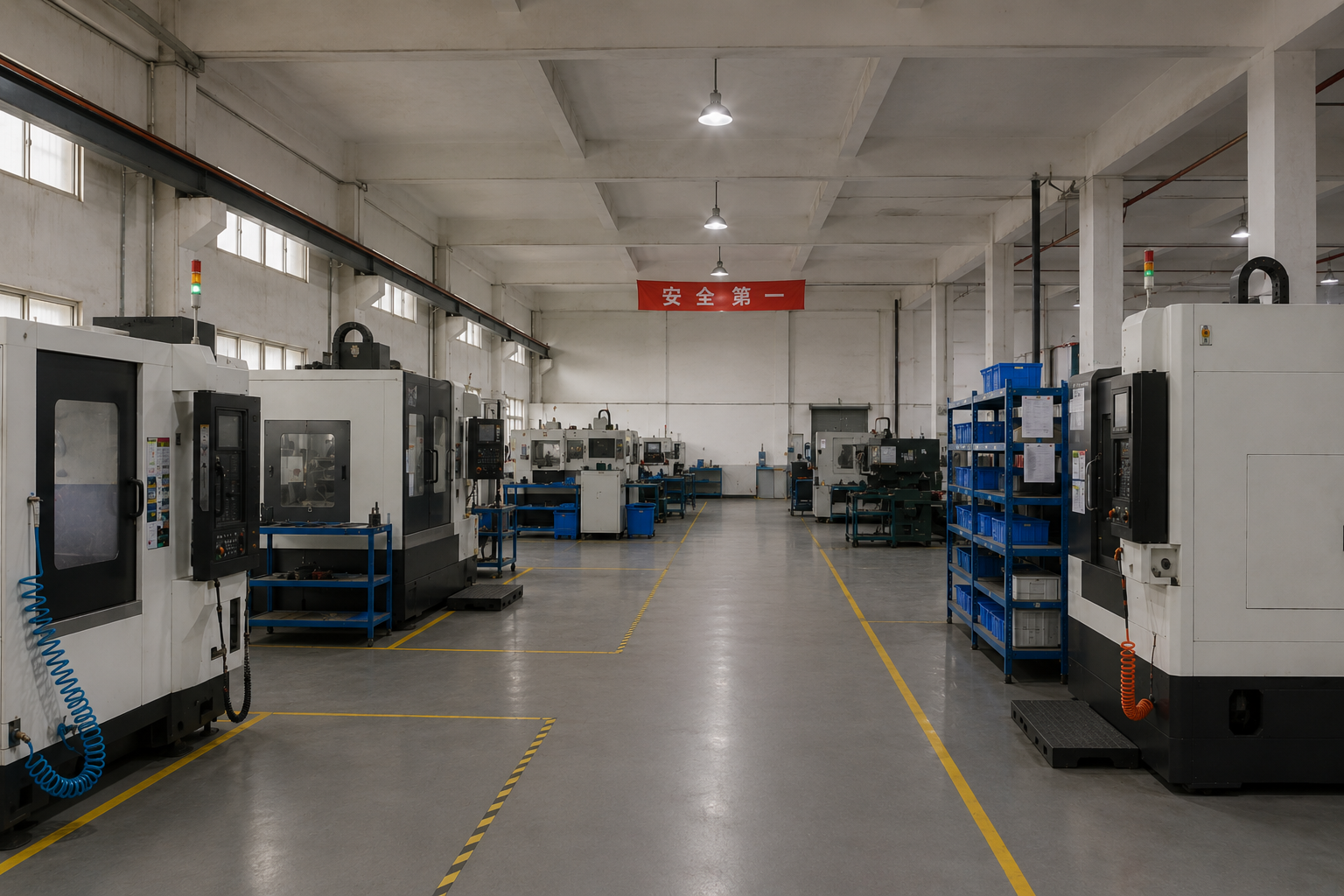
Control pendant station production at the WILMALL workshop in Wenzhou, China.
The COP-5MSS-DD station, element by element
WILMALL — the brand of Wenzhou Mofan Electric Technology Co., Ltd., an industrial electrical manufacturer and one-stop B2B supplier based in Yueqing City, Wenzhou, China — lists the COP-5MSS-DD as a control pendant within its control pendant station range. Its published characteristics are deliberately unglamorous, and each one answers a specific operator question.
Plastic housing. The enclosure is plastic, which keeps the handheld unit light enough to hold through a shift and removes the corrosion question that metal housings raise in humid or chemically active plants. It also means the housing is not the place to look for impact resistance — handling discipline on site is.
AC 500V / 10A rating. The station is rated for AC 500V and 10A. That is the switching envelope, not an instruction to wire it to 500V. Most crane and hoist control circuits run at a much lower control voltage, and the rated value simply confirms that the button contacts can carry the circuit they are installed in with margin. Confirm the actual control voltage against the hoist documentation before wiring.
IP65 protection. IP65 means dust-tight and protected against water jets. For a pendant that is the difference between a station that survives a washdown-adjacent bay and one that ingests dust until a button stops returning. It is not a claim that the unit can be submerged, and it does not extend to a damaged cable gland.
-25 °C to +40 °C operation. The rated operating range is -25 °C to +40 °C. Cold-store, freezer-room and unheated outdoor installations in winter often sit inside the lower bound. Foundries, roof-level crane cabs in summer and heat-treatment bays often do not sit inside the upper bound. When ambient conditions fall outside the range, the IP65 and electrical ratings should not be assumed to hold.
Push-lock emergency stop. The emergency stop on the station is a push-lock type: pressing it latches the button in the operated position, and it stays latched until deliberately released — normally by twisting or pulling the actuator, depending on the design. That latching behaviour is the whole point. A momentary button releases the moment the operator lets go; a push-lock stop records that a stop was commanded and forces a conscious reset before the machine can restart.
Step-by-step: a shift-level walkthrough of the station
The sequence below is written for the operator and the maintenance technician who share the same pendant. It does not replace the machine manufacturer's instructions, but it covers the button-level checks that prevent most avoidable incidents.
Step 1 — Read the faceplate before pressing anything
Match each of the five positions to its label and to the machine's wiring diagram. On a retrofit, assume nothing: labels travel with the housing, wiring travels with the panel. A five-button station retrofitted onto a hoist whose travel axis was re-assigned is a common source of "the pendant is wired backwards" complaints.
Step 2 — Confirm the electrical envelope
Check the control voltage of the circuit the station is connected to, then confirm it falls within the AC 500V / 10A rating. Under-rating is a fault; a large margin is normal. Record the control voltage on the asset tag so the next technician does not have to re-derive it.
Step 3 — Verify the push-lock emergency stop at the start of every shift
Press the e-stop, confirm the machine's control circuit drops out and the button remains latched, then release it and confirm the machine will not restart until the reset procedure has been completed. This is a two-minute check that validates the one button nobody wants to be testing for the first time during an incident.
Step 4 — Test each motion unloaded
With no load attached, operate each of the four motion buttons in turn. Listen for the contactor, watch the direction, then release. A button that returns slowly, feels gritty, or needs to be pressed twice has a mechanical problem that will get worse under load.
Step 5 — Operate under load, one motion at a time
Run the first loaded lift using single-button commands and confirm each direction matches the faceplate. Whether the control circuit allows two motions to be commanded at the same moment depends on the hoist and panel design rather than on the pendant alone. If the application needs combined motion, that has to be engineered into the control circuit and verified deliberately, not discovered by experiment.
Step 6 — Park the station correctly
Return the pendant to its designated rest position instead of letting it hang on its cable. Cable strain at the entry gland is the most common route by which an IP65 housing stops being IP65.
Step 7 — End-of-shift inspection against the rated envelope
Check the housing for cracks, the gland for tightness, each button for full return, and the e-stop for a clean latch. Then check the ambient condition: if the bay has drifted outside -25 °C to +40 °C, treat any intermittent behaviour as an environment issue before replacing hardware.
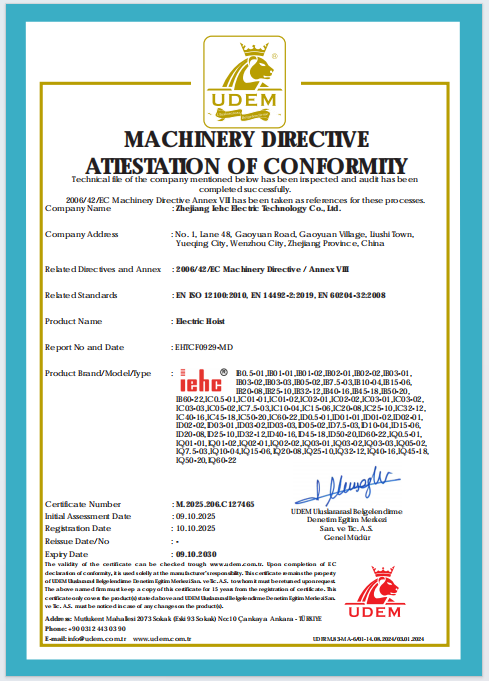
Machinery Directive attestation of conformity EHTCF0929-MD, issued by UDEM, covering the electric hoist scope.
Where a 5-button station fits: use cases
Overhead and bridge cranes. The classic application. One operator at floor level commands hoist and travel while watching the load, with the emergency stop in the same hand as the motion buttons.
Electric chain hoists. A 5-button pendant is commonly paired with a hoist as the local control interface, with the hoist documentation governing the control circuit and the pendant governing the operator inputs. Keeping those two documents separate is what makes fault-finding possible later.
Industrial machinery and assembly areas. Beyond lifting, industrial pendant control is used wherever an operator needs motion control away from a fixed panel. One documented deployment is an RV factory in Australia, where 10 units of the COP-5MSS-DD control pendant were installed for control device applications. The reported result after roughly a year in service was stable operation, with "easy to use" cited as the highlight. It is a small sample, but a real one, and it shows the pattern: in assembly environments the pendant's value is that the operator never has to walk back to a cabinet.
WILMALL's export mix reflects similar environments — Australia, Pakistan, South Korea and Malaysia are listed markets, with an export ratio of 80%.
Comparison: fixed specification vs configurable options
The COP-5MSS-DD's published characteristics are fixed. Around them, WILMALL offers configuration under an OEM/ODM production model. Separating the two is the fastest way for a buyer to tell what is a specification and what is a choice.
| Parameter | COP-5MSS-DD (fixed specification) | Documented configuration range |
|---|---|---|
| Housing material | Plastic | Fixed |
| Rated voltage / current | AC 500V / 10A | Fixed |
| Ingress protection | IP65 | Fixed |
| Operating temperature | -25 °C to +40 °C | Fixed |
| Button count | 5 | 2, 4, 6 or 8 buttons |
| Button function options | Push-lock emergency stop | Emergency braking button available as a button function |
| Contact point material | Not a configuration variable | Silver or copper |
| Button speed | Not a configuration variable | Single speed or dual speed |
| Production mode | Standard unit | OEM / ODM |
| Quality control | 100% test | 100% test |
| Minimum order quantity | — | 5 units |
| Lead time | — | 15 working days |
| Monthly capacity | — | 2,000 units |
| After-sales support | — | Remote technical support |
A 5-button layout is the configuration this walkthrough describes. The same platform is offered with 2, 4, 6 or 8 buttons where a machine has fewer or more motions to command. Buyers should size the station to the motion count rather than adding secondary controls elsewhere on the machine.

Order handling and configuration review for control pendant station projects.
Frequently asked questions
Which standard applies to the buttons on a pendant control station?
IEC 60947-5-1:2024 is the current international standard for electromechanical control circuit devices and switching elements, the category that pendant switches belong to. Machinery-level conformity is documented separately: an electric hoist supplied by WILMALL carries a Machinery Directive attestation of conformity, certificate EHTCF0929-MD, issued by UDEM for the Turkish market, valid from 2025-10-09 to 2030-10-09 and referencing EN 14492-2:2019 and EN 60204-32:2008. A pendant's own IP65 and AC 500V / 10A ratings address ingress and switching capacity — they do not demonstrate the machine's conformity, so buyers should keep the component evidence and the machine evidence in separate files.
Can the 5-button layout be changed if the machine needs different functions?
Yes. Under its OEM/ODM production model, WILMALL documents configuration options for the control pendant range: button counts of 2, 4, 6 or 8; contact point material in silver or copper; an emergency braking button as a button function; and single-speed or dual-speed button operation. Every unit is 100% tested, monthly capacity is listed at 2,000 units, and the export markets covered include Australia, Pakistan and South Korea. Changing the button count changes the faceplate and the wiring, so the configuration should be agreed in writing before production rather than adjusted at commissioning.
What drives the unit cost of a 5-button pendant?
There is no published price list, because the cost varies with the configuration rather than with the model name. The variables that move the number are the contact point material (silver or copper), the button count, whether an emergency braking button function is specified, and whether the button speed is single or dual. The minimum order quantity of 5 units keeps the cost of a first evaluation small enough that a buyer can test the configuration on a real machine before committing to a larger volume.
Can a sample be validated on a real crane before a bulk order?
Yes — a 5-unit minimum order is small enough to serve as a validation batch. Units are 100% tested before shipment, the standard lead time is 15 working days, and remote technical support is available during commissioning. The practical validation path is the one already used in the field: an RV factory in Australia installed 10 units of the COP-5MSS-DD for control device applications and reported stable operation after roughly a year, with ease of use as the stated highlight. To arrange an evaluation batch, contact WILMALL at sales@wilmall.com with the button count, contact material and speed configuration you need.
What is the lead time for a configured pendant station?
The standard lead time is 15 working days, against a documented monthly capacity of 2,000 units. For projects with a fixed installation date, place the order against the commissioning schedule rather than the purchase-order date, and confirm the configuration — button count, contact material, emergency braking button, single or dual speed — before production begins. Buyers operating across multiple sites can also request the current catalogue for reference.
Conclusion: know the five switches before you buy the station
A 5-button control pendant is not a complicated device, and that is exactly why it is worth understanding properly. Five switches, one latched emergency stop, and a defined envelope of AC 500V / 10A, IP65 and -25 °C to +40 °C describe almost everything an operator needs to know and almost everything a buyer needs to verify. The COP-5MSS-DD from WILMALL fits that description, sits in a documented configuration range of 2 to 8 buttons with silver or copper contacts and single or dual speed, and is supported by a 5-unit minimum order, 15 working days lead time and remote technical support.
The discipline that matters is the one covered in the walkthrough: label the faceplate to the circuit, test the push-lock stop at the start of every shift, keep the station inside its rated temperature and ingress envelope, and park it rather than letting it hang by its cable. Those four habits do more for uptime than any specification upgrade.
Next step
Download the WILMALL product catalogue for the full control pendant station range, or send your button count, contact material and speed requirement to sales@wilmall.com / WhatsApp +86 19730226757 for a configured quotation and a 5-unit evaluation batch.

Stock and dispatch for control pendant station orders — 15 working days standard lead time.
Have Questions or Need More Details?
Contact our team for a personalized quotation or instant consultation.
Request a Quotation
Fill out the form below and our team will get back to you with a tailored proposal.
WhatsApp Direct Chat
Prefer to chat in real-time? Message us on WhatsApp for instant assistance & quick answers.
- Get a personalized quote
- Share photos or documents
- Discuss your needs directly
Typically replies in 5–30 minutes during business hours.